State and local government entities, including public school districts, must meet WCAG 2.1 Level AA under ADA Title II by April 2027 or April 2028
Private businesses are not under the Title II deadline, but Title III and state laws still create accessibility obligations
The three most common audit findings are low text contrast, missing alt text, and navigation that breaks assistive technology
Website accessibility has moved from a recommended best practice to a documented federal compliance requirement for a specific set of organizations. Under the Department of Justice's 2024 final rule implementing ADA Title II, state and local government entities are required to meet WCAG 2.1 Level AA standards for their websites and mobile applications. Public school districts and other public entities fall within this rule based on the sizing formula the Department of Justice sets out in the regulation.

Private businesses are not covered by this specific Title II deadline. However, businesses that serve the public may still have accessibility obligations under ADA Title III and under other federal and state laws, and courts have applied those obligations to websites in numerous cases. Any organization that maintains a public-facing site should have a considered approach to accessibility, regardless of whether the new Title II timeline applies to it directly.
The sections that follow outline what the Title II rule requires, which organizations it covers, what the technical standard involves in practice, and how our team recommends approaching the work.
The New Title II Requirement, in Plain Language
Under the 2024 final rule, state and local government entities are required to bring their websites and mobile applications into conformance with WCAG 2.1 Level AA. Following an Interim Final Rule published by the Department of Justice in April 2026, the compliance dates were extended by one year.
The current dates are April 26, 2027 for larger entities and April 26, 2028 for smaller entities and special district governments, with the applicable date determined by the Department's own population calculation rather than by any general estimate of who the entity serves.
Public school districts, community colleges, county libraries, and other public entities are covered under this same framework. A district or public entity should confirm its applicable compliance date by reviewing the Department of Justice guidance and, where appropriate, consulting counsel.
Bringing a website into WCAG 2.1 Level AA conformance is not a task that can be handled shortly before the deadline. It involves reviewing how content is structured, how color systems are applied, how images are documented, and how visitors navigate the site. A website designed several years ago without accessibility considerations will rarely pass a formal review on the first attempt, which is why our team incorporates accessibility standards into every website we design from the outset.
What WCAG 2.1 Level AA Involves
The Americans with Disabilities Act requires that public-facing services be accessible to individuals with disabilities. In the built environment, that requirement takes the form of ramps, elevators, and appropriate doorway widths. In the digital environment, it means that individuals using screen readers, keyboard-only navigation, magnification software, or captioning are able to access the same information and services offered to all other visitors.
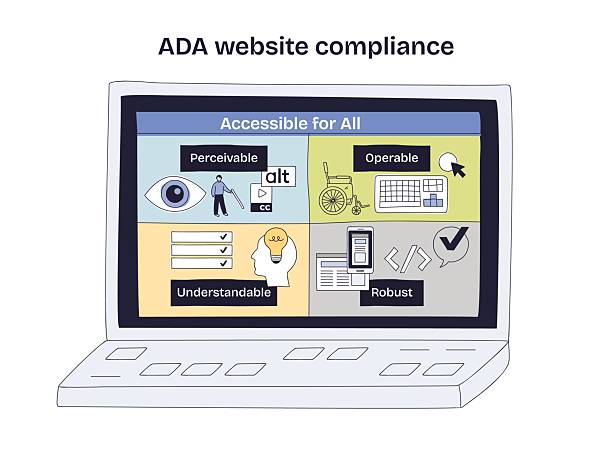
The technical standard referenced by the Department of Justice is WCAG 2.1 Level AA, published by the World Wide Web Consortium. It is organized around four principles.
- •
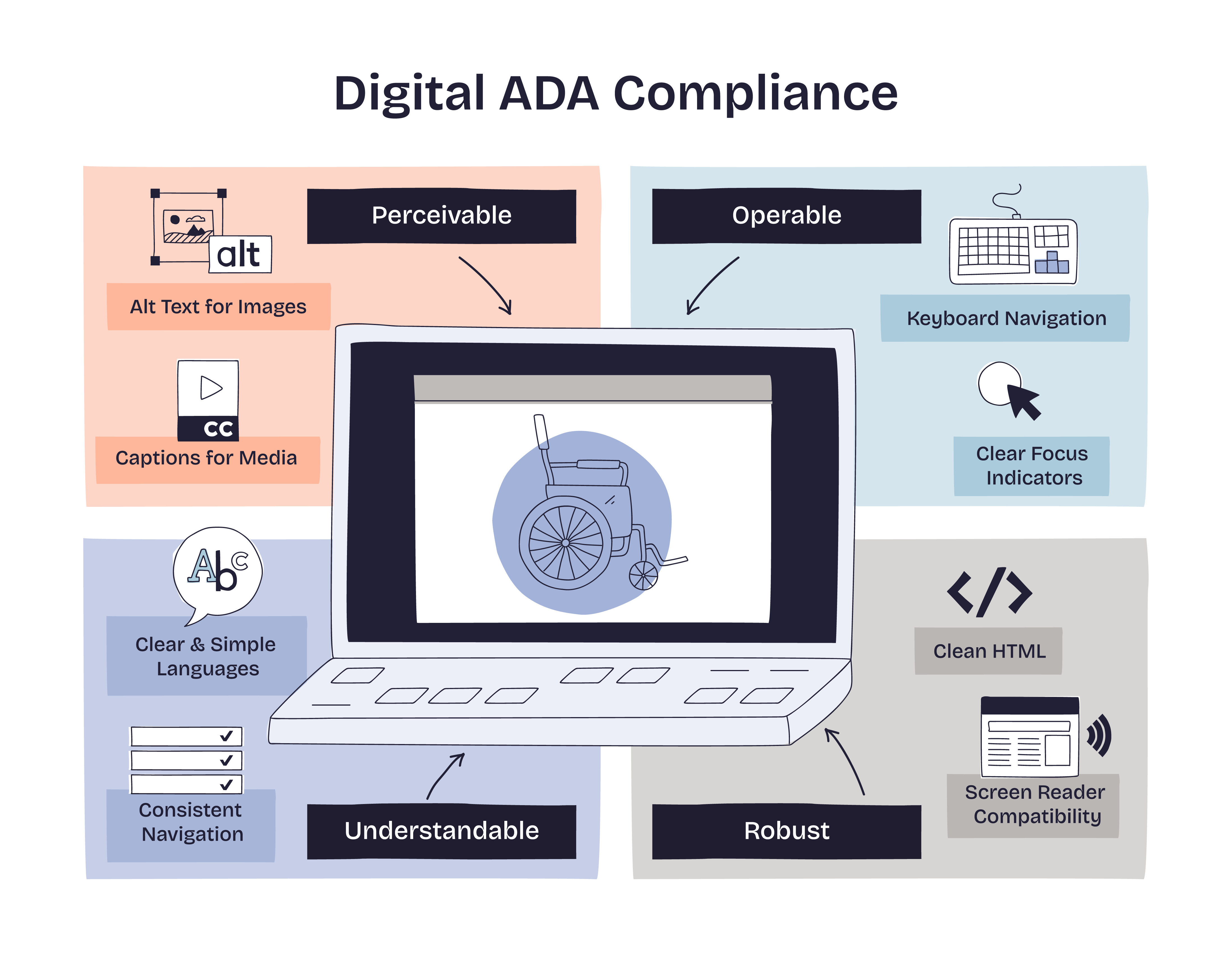
Perceivable. Content is presented in ways users can perceive, which includes sufficient color contrast, alternative text for images, captions for video, and text that can be resized without loss of function.
- •
Operable. Interactive elements function through keyboard input rather than requiring a pointing device. Content does not include effects that could trigger seizures, and users have adequate time to read and interact.
- •
Understandable. Text is readable, navigation behaves predictably, and forms clearly communicate errors and required corrections.
- •
Robust. Content is compatible with current assistive technologies and remains compatible as those technologies evolve.
Meeting these principles rarely requires a full redesign. It requires deliberate decisions at the code, content, and design levels.
The Three Findings We See Most Often in Audits
When our team conducts an accessibility review, three findings recur across most sites. These issues are common on school, municipal, nonprofit, and business websites alike.
Insufficient Text Contrast
Light gray text on a white background may appear refined in a design mockup, but it is unreadable for many users with low vision and falls below the general WCAG AA contrast minimums. Those minimums are 4.5 to 1 for normal text and 3 to 1 for large text, with certain exceptions defined in the standard.
A significant number of modern websites fall below these minimums on their most critical pages, including hero sections, calls to action, and form labels. Individual pages can be tested against these ratios using the WebAIM Contrast Checker or the WAVE tool.
Missing Alternative Text
Every meaningful image on a website should include descriptive alternative text so that screen readers can convey its content to users with visual impairments. A filename such as image1.jpg does not satisfy this requirement, and neither does an empty attribute on a substantive image. The W3C alternative text decision tree provides authoritative guidance for the edge cases in which alternative text should intentionally be left blank.
Navigation That Does Not Accommodate Assistive Technology
Menus that respond only to hover, dropdowns that trap keyboard focus, icons without accessible labels, and the absence of any accessible mechanism to bypass repeated navigation all impede visitors using assistive technology. WCAG requires that users be able to bypass blocks of content that repeat on multiple pages. A visible skip link is one common way to satisfy that requirement, but it is not the only one; the standard is that some accessible bypass mechanism be available.
Which State and Local Government Organizations Are Directly Affected
The Title II compliance deadline applies to state and local government entities. Every public-facing organization should have an accessibility plan, but only certain public entities are subject to this specific federal deadline.
Directly covered under Title II are state agencies, city and county governments, courts, and any public agency that provides services to the public. Public school districts, public colleges and universities, and other public educational institutions are covered as well, with their applicable date determined by the Department of Justice's population calculation.
Publicly operated libraries, community centers, and similar public entities generally fall within Title II. Privately operated nonprofits and community organizations are a separate matter; they may have their own accessibility obligations under Title III or under other federal and state laws, but the specific April 2027 and April 2028 Title II deadlines do not automatically apply to them. Nonprofits that receive federal funding should also consider Section 504 of the Rehabilitation Act.
Private businesses that serve the public online, including retailers, medical practices, restaurants, and professional service providers, have faced litigation under ADA Title III when their websites were not accessible. Title III does not currently include the specific WCAG 2.1 AA reference or the April 2027 or 2028 deadlines that Title II now sets out, but the underlying accessibility obligation exists, and courts have applied it to websites.
The Business Case for Accessibility Beyond Legal Compliance
Framing accessibility solely as a mechanism for avoiding litigation understates its value.
An accessible website is easier for every visitor to use. Larger tap targets benefit mobile users, higher contrast supports readability in bright environments, clear navigation assists first-time visitors, and captioned video accommodates users in sound-sensitive environments. The population that benefits from accessible design substantially exceeds the population with a formally documented disability, and the Centers for Disease Control and Prevention estimates that roughly one in four American adults lives with a disability of some form.
Many accessibility best practices also support search engine optimization and general usability, since accessible sites tend to use clear semantic structure, descriptive alternative text, and well-labeled navigation. This overlap is one of the reasons our SEO work and our website design work are closely integrated.
What Accessibility Work Looks Like in Practice
Our team incorporates accessibility standards into every new website from initial design. For existing sites, remediation typically involves:
- •
Auditing the color palette and correcting any text that falls below WCAG contrast minimums
- •
Adding descriptive alternative text to every meaningful image
- •
Rebuilding navigation to support keyboard input and screen readers, with an accessible mechanism to bypass repeated content
- •
Ensuring forms include visible labels, clear error messages, and visible focus states
- •
Providing captions for video and transcripts for audio
- •
Testing with real screen reader software such as NVDA or VoiceOver rather than relying exclusively on automated tools
Automated testing tools identify a portion of accessibility issues but not all of them. Meaningful review requires both automated scanning and manual evaluation by a person navigating the site as a screen reader user or keyboard-only user would.
The Cost of Waiting
Every month of inaction moves a covered organization closer to a fixed compliance date. The Department of Justice extended the original deadlines by one year in April 2026, but no further extensions have been announced, and covered organizations should not plan on additional relief.
Accessibility work takes time, since auditing, prioritization, remediation, and retesting occur sequentially, and attempting to condense the process into the final months before the deadline increases both cost and risk.
Beyond the deadline itself, an inaccessible website affects visitors every day: users who cannot read the homepage, cannot complete the contact form, or cannot access information they need from a public agency, school, or business.
Recommended Next Steps
Organizations that are uncertain about the current state of their website should begin with a formal accessibility review. A thorough review will identify what is failing, why it is failing, and what will be required to correct it. That transforms the effort from an undefined liability into a defined, manageable project.
Our team helps organizations across our service area work toward and maintain WCAG 2.1 Level AA conformance by auditing the current state of their websites, prioritizing the remediation items with the greatest impact, and rebuilding the elements that require it. Additional information is available through our ADA compliance services and website design services.
The April 2027 Deadline Is Closer Than It Looks
Auditing, remediation, and retesting take months, not weeks. If you run a public agency, school district, or business that serves the public online, let's review where your site stands and build a plan to get it there before the deadline.
Request an Accessibility Review